


Finger joints most often begin to hurt after 40-45 years (in 1 out of 10 people this is due to age-related changes in the body).After 60 years, pain often occurs against the background of polyarthrosis (damage, destruction of articular cartilage of various joints).
Deformation and destruction of the joints of the hands are diagnosed in 10% of elderly people.
In addition, pain in the finger joints is a characteristic sign of diseases such as:
- rheumatoid arthritis (in 80% of cases it begins with inflammation of the finger joints);
- psoriatic arthritis (in 70% of cases, the fingers are the first to suffer);
- gout (arthritis affecting the fingers occurs in 10-15% of gout patients);
- osteomyelitis is an infectious inflammation of bones (accounts for 6.5% of all diseases of the musculoskeletal system).
Most arthritis, in which the finger joints are the first involved in the process, are systemic diseases (that is, they affect different systems of the body, not just the joints).They are also often diagnosed in people of all ages, including young people;in men, they occur 3 to 5 times less often.
Another cause of pain are mechanical injuries, the consequences of blows or bruises to the hands (often in athletes the prevalence reaches up to 40% of all traumatic injuries).
Some of the diseases that cause pain in the finger joints cannot be completely cured;over time, they become a cause of disability (rheumatoid, psoriatic arthritis, polyarthritis).And, for example, with timely treatment, osteomyelitis can be eliminated forever, but the process quickly becomes chronic and can lead to loss of a limb (in 30% of cases).
If you suspect a systemic disease (arthritis, polyarthrosis), you should consult a rheumatologist or arthrologist.Osteomyelitis is treated by an orthopedist-traumatologist, surgeon, injuries - by an orthopedist-traumatologist.
Why does pain appear in the joints of the fingers: causes and symptoms
Why do my finger joints hurt?There are many reasons, as well as factors that can speed up or speed up the process.Predisposing factors common to all illnesses and injuries can be considered:
- Profession (this category includes people forced to work with hands and fingers, musicians, seamstresses, programmers).
- Stress (injuries and microtraumas resulting from long hours of training and sports rehearsals).
- Hormonal changes, disorders (pregnancy, lack of estrogen in elderly women).
- Heredity (close relatives are more susceptible to systemic diseases).
- Immune system deficiencies or diseases.
- Metabolic disorders (gout, diabetes).
- Chronic infections (tuberculosis).
- Hypothermia (hypothermia).
- Some long-term negative factors (among them - taking medications, poisoning with toxic substances in a dangerous company, smoking, alcoholism, etc.).
The article below describes the pathologies and conditions that cause pain in the finger joints.
Injuries
The pain that appears after an injury is difficult to confuse with something else:
- all symptoms occur immediately after a blow, bruise, compression or other damage;
- severe pain is accompanied by swelling, bruising at the impact site, impaired joint mobility;
- with moderate and severe damage, the symptoms do not subside for a long time, but become more pronounced - pain, stiffness, swelling;
- the discomfort intensifies when trying to bend or straighten the fingers.
Serious injuries to the fingers of the upper limb are associated with:
- ruptures of muscles, ligaments, blood vessels, hemorrhages of the capsule (hemarthrosis) and soft tissues (hematomas);
- bone fractures and cracks;
- nerve damage (loss of sensitivity in fingers and skin).
Prognosis: Minor injuries heal without leaving a trace in 90 to 95% of cases.Severe and moderate injuries can lead to various complications - from impaired sensitivity of the fingers to traumatic arthritis in 70% of cases.
Polyarthrosis
Polyarthrosis is a chronic pathology, as a result of which the finger joints are gradually deformed and destroyed (there is a form of the disease that affects the thumb joints - rhizarthrosis).

At first, aching pains appear after hard work (sewing, embroidery, several hours of rehearsing a musical instrument).As the disease progresses:
- pain in the finger joints becomes constant and does not disappear with rest;
- pain is accompanied by clicking and crunching (during movements);
- stiffness appears (slight at first).
During periods of exacerbation, the main symptoms include swelling, swelling, increased local temperature, and sometimes redness in the joints.
Over time, fingers become deformed:
- Heberden's nodes (bony growths, pea-sized lumps) form on the joints located closer to the nails.
- Bouchard's nodes (proliferation of joint surfaces, bone spurs) form on the middle joints.
The finger joints lose their initial shape (become knobby), and over time they lose mobility due to ossification of soft tissues (ankylosis).
Prognosis: the pathology is incurable, but in the early stages (until the deformation appears) it can be stopped for a long time.Later, this becomes a cause of disability (the tissues group together, ossify, finger mobility can only be restored by surgery).
Rheumatoid arthritis
Chronic inflammatory disease of the joints, which occurs with the involvement of other organs and systems in the pathological process (outer wall of the heart, lungs, vascular walls, skin).
Rheumatoid arthritis is characterized by:
- gradual increase and intensification of symptoms (at first, the exacerbation is replaced by fairly long periods of asymptomatic progression, but they become shorter and shorter over time);
- morning stiffness, reminiscent of tight gloves (disappears in 30 to 60 minutes);
- sharp, sharp, annoying pain in the joints of the fingers (of both hands), which intensifies until it becomes unbearable when bending;
- redness, swelling, swelling, joint stiffness.
The pain syndrome usually occurs at night or in the morning and subsides slightly in the afternoon.
When acute symptoms disappear (during remission), the pain becomes less pronounced, aching and intensifies with movements and when working in cold water.The finger joints hurt when flexion and extension, remain painful to the touch and slightly swollen.
Gradually, the disease leads to the formation of a stable deformation and dysfunction of the fingers - they turn outward or upward, bend (the middle finger, index finger and ring finger are most often affected, extremely rarely - the little one and thumb), other joints are involved in the process (wrists, ankles, knees, shoulders).
Prognosis: the pathology is incurable, progresses rapidly and leads to loss of ability to work, disability - 40% of cases during the first 5 years of development.
Psoriatic arthritis
Psoriatic arthritis is one of the forms of a serious systemic disease (psoriasis).
The most characteristic signs of finger joint damage:
- sudden and sudden onset of arthritis;
- damage to the interphalangeal and distal joints (closer to the nail);
- constant, even severe pain, associated with significant swelling, redness of the skin, limited mobility (the shape of the fingers at this time resembles a radish or sausage, it is impossible to bend or straighten the finger joints due to pain and swelling);
- increase in general temperature.
In the long term, this leads to the destruction of the nail plates (they crumble and lose their shape), deformation of the fingers (they “turn” outwards or upwards) and loss of working capacity.
Prognosis: psoriatic arthritis is incurable, severe, progresses rapidly and causes disability in 90 to 95% of patients.
Gouty arthritis
Gouty arthritis occurs against the background of metabolic disorders, which cause excessive accumulation of uric acid in the body.It enters the tissues of the joints, causing inflammation.
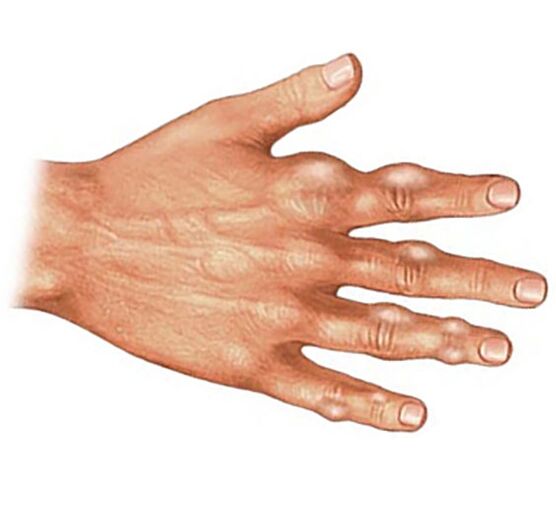
Typical signs of gouty arthritis:
- Sharp, sudden, shooting, or burning pain in one or more finger joints.
- Any attempt to move a finger or touch it increases the unpleasant symptom.
- It is accompanied by severe swelling, which often spreads to the entire hand, a change in skin color (the finger of the hand becomes bluish-purple) and an increase in general temperature (the patient has fever, chills).
- Pain in the finger joints usually occurs at night.
- The attack can last from 2 days to 2 weeks.
Progressive gouty arthritis leads to the involvement of new joints in the process and their deformation (destruction of joint surfaces).Tophi appear on the fingers - tissue deposits of uric acid.
Prognosis: There is no cure for gout, but normal uric acid levels can be maintained with medication and diet.The disease rarely causes complete disability of the patient (5 to 8%), but over time it can destroy the joints of the fingers (secondary osteoarthritis).
Why else might your finger joints hurt?
Other causes of pain may include the following diseases and conditions:
Osteomyelitis
This infectious lesion of the bones (periosteum, spongy and compact substance) usually begins acutely - the pain in the joints with osteomyelitis is strong, sharp, jerking, bursting or tearing.In flexion or extension, it intensifies until it becomes unbearable, accompanied by significant swelling, redness and hardening of the tissues at the joint, fever and signs of general intoxication (weakness, sweating).In 30% of cases, osteomyelitis becomes chronic (may recur) and the pain in the fingers becomes painful.The process can cause purulent arthritis, malignancy of bone tissue, deformation of bones and joints.
Vasospasm
Vasospasm is a sudden narrowing of the peripheral vessels supplying blood to the upper limbs, hands and finger joints.It is characterized by tingling sensations, numbness and pale skin.At the end of the attack (which can be short-lived - from 2 minutes, or long-lasting - up to 60 minutes), the fingers begin to hurt, "ache" and the skin of the hands turns red.Over time, this phenomenon (vasospasm) causes the appearance of trophic ulcers (tissue death due to nutritional disorders), bone wasting and necrosis of the fingertips.
Pregnancy
Pregnancy is not a pathological condition, but it is accompanied by sharp and rapid hormonal changes in the body and accelerated metabolism.Pain in the joints of the fingers, or rather aches, can be caused by a lack of calcium and vitamin D3, as well as an excess of the hormone that prepares the body for childbirth by loosening the ligaments.
Diagnosis: methods, research
When your finger joint hurts, what should you do?First of all, it is necessary to diagnose the pathologies causing such a symptom.Most often, the attending physician prescribes a number of analyzes:
| Method name | What allows you to diagnose |
|---|---|
X-ray |
With its help, pathological changes in bones, deformations of joints, crystal deposition and ossification of tissues are detected. |
MRI, CT scan or ultrasound |
These diagnostic methods make it possible to identify possible pathological changes in periarticular tissues and joints that are not visible on x-rays. |
ECG, ultrasound of internal organs |
Helps identify extra-articular manifestations characteristic of certain diseases (pericarditis, pneumonia) |
Angiography |
The study of blood vessels is informative about pathologies that arise with damage to their walls and can cause vasospasm (rheumatoid arthritis) |
Clinical laboratory tests |
With the help of tests, the cause of the disease is determined, infections and pathogens of the pathological process are identified. |
Therapeutic and diagnostic puncture of joints (procedure for extracting fluid from the joint capsule) |
A puncture is carried out if blood has accumulated there (hemarthrosis), pus (infectious process) or a large amount of fluid, which hinders mobility and threatens its destruction. |
Treatment: principles, drugs, characteristics
Some diseases or conditions that cause pain in the finger joints cannot be cured (vasospasm, osteoarthritis, psoriatic arthritis, gouty).Some are completely cured and without consequences (with timely treatment - osteomyelitis, light and moderate injuries).
General principles of treatment, methods of pain relief
What is common in the treatment of all diseases causing pain in the joints of the fingers is the prescription of medications that help eliminate serious symptoms.
These are usually:
- nonsteroidal anti-inflammatory drugs (NSAIDs), which successfully relieve inflammation and pain;
- glucocorticoids, which are prescribed if NSAIDs are ineffective;
- painkillers if joint pain cannot be relieved by other means.
As soon as the symptoms disappear, the patient is prescribed: chondroprotectors to slow down or prevent the destruction of the cartilage, and physiotherapy.
Physiotherapy stimulates metabolic processes and accelerates tissue restoration.The most popular physiotherapeutic procedures for joint diseases are:
- electrophoresis with drugs;
- magnetic therapy;
- UHF (ultra high frequency therapy);
- reflexology (acupuncture);
- massage;
- mud therapy;
- balneotherapy (hydrotherapy);
- warming procedures (paraffin applications, ozokerite);
- therapeutic exercises (exercises to strengthen the finger joints).
If it is necessary to eliminate pain in the finger joints and their causes, sanatorium treatment can give a good result.Under the guidance of the attending physician, the patient is given the opportunity to change the climate 1-2 times a year, undergo a course of restorative physiotherapy and drink mineral water from natural springs.
Features of treatment of specific pathologies
In addition to general methods and means, there are nuances in the treatment of each pathology:
| Pathology | Treatment characteristics |
|---|---|
Injuries |
Treatment of injuries is progressive.Initially, the victim receives first aid (fixing bandage, ice compress for 24 hours). If necessary, a puncture is performed, tissue integrity is restored (in case of serious damage) and immobilized with plaster. On days 3 and 5, they begin to warm up, stimulating healing. |
Polyarthrosis |
At the beginning of the disease, taking chondroprotectors and physiotherapy are effective. Later, only surgery helps (the problem is solved with prostheses). |
Rheumatoid arthritis |
Prescribe basic anti-inflammatories, antibiotics, antibacterial, antiallergic drugs, drugs that affect the activity of the immune system. |
Psoriatic arthritis |
|
Gouty arthritis |
The underlying disease (gout) is treated by prescribing drugs that regulate the formation and accelerate the excretion of uric acid, drugs that dissolve salt deposits in the tissues. An obligatory element of treatment is a strict diet during an attack (table No. 6), a less strict diet throughout life. |
Osteomyelitis |
Surgical washing of purulent cavities of bone tissue and opening of ulcers are carried out. Antibiotics and antibacterial drugs are used for treatment. |
Vasospasm |
How to treat vasospasm?In case of pathology, vasodilators and antispasmodics (relaxing the muscles of the vascular walls), anticoagulants are prescribed. Eliminate provoking factors (eg, smoking) or treat the underlying disease causing vasospasm (eg, rheumatoid arthritis). |
Folk remedies (treatment of pathologies, pain relief)
Pain in the joints of the fingers can also be treated with folk remedies:
- Infusion of eucalyptus leaves.Take 40 g of eucalyptus leaves, pour a liter of boiling water, leave for 60 minutes under the lid.Once ready, strain, pour into a dark glass container and store in the refrigerator.Take every day for 2 weeks - 3 times 50 ml, 30 minutes before meals.
- Treatment of pain in the joints of the fingers with infusion of black currant leaves.Pour 10 g of raw materials into 0.5 liters of boiling water, let it brew under the lid for 20 minutes.Drink a glass 2 to 3 times during the day.The course duration is 2-3 months.
- Warming ointment for arthritis.Take 50 g of camphor and mustard powder, dilute them one by one in 100 ml of alcohol, add the beaten egg white.Rub on brushes overnight.Treatment of finger joints continues for 21 days, after a while the treatment can be repeated.
- Oil rubbing.Dilute fir essential oil with vegetable oil (1:1), rub it into the joints of your fingers until completely absorbed before going to bed.First you need to “warm them up”: boil the washed potato peelings in water, after the broth has cooled (until it is pleasantly hot), dip your brushes into it and hold them for 15-25 minutes, then rinse them with clean water.Treatment continues for 3 weeks or until signs of the disease disappear.
Prevention
How to prevent pathologies that cause pain in the finger joints?To do this you need:
- get rid of bad habits (stop smoking and drinking alcohol);
- introduce foods into the diet that are beneficial for joints and cartilage tissues (with sufficient calcium, phosphorus, other minerals and vitamins, proteins);
- undergo regular examinations to eliminate foci of chronic infection (for example, tonsillitis);
- do not overload (alternate load and rest) and do not overcool your hands.
It is very important to strengthen the immune system (swimming, yoga, walking) and finger joints through therapeutic exercises.